Tied, rolled and bundled: storing the awkward shapes
Storage is mostly written for things that fit in boxes, and a house is full of shapes that do not. The awkward ones live by being rolled, bundled and tied, and the tying is a small skill worth doing on purpose.
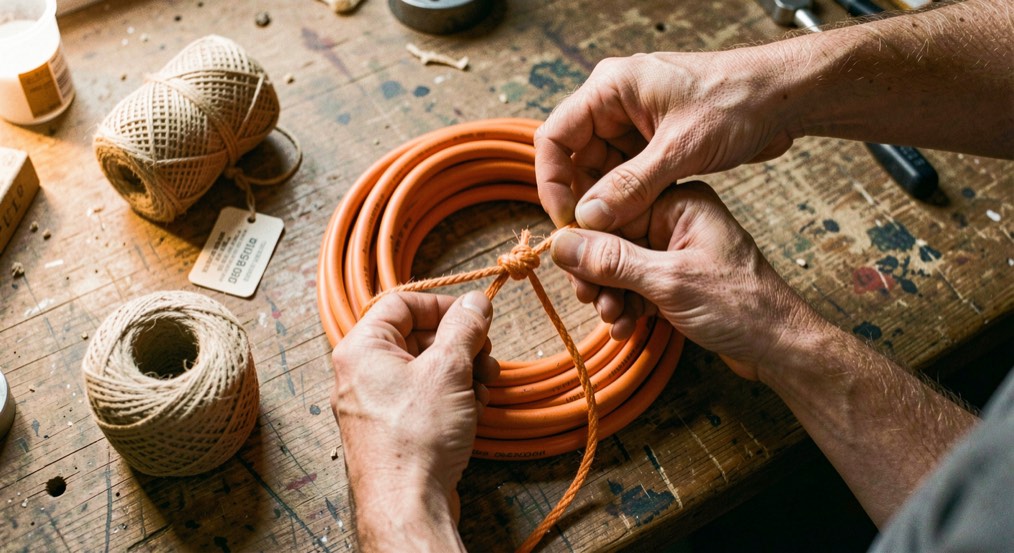
The rolled rug, the bundle of garden canes, the extension lead, the spare curtain pole, the tarp folded away for winter: none of them sits on a shelf, and all of them get worse in the pile where they are usually left. They are stored by rolling, bundling and tying, and the skill set involved is smaller than it looks. Three knots cover almost everything a house asks of a length of cord.
What gets rolled rather than shelved
A rug or a mat rolls pile outwards, so the surface is protected and the roll lies flat; a stiff carpet rolls around a cardboard tube and is tied at both ends and the middle. Paper goes between the layers rather than plastic, which traps the same damp the wrapping was meant to keep out.
Canes, stakes and poles bundle rather than lie loose, because ten loose canes occupy a whole corner and ten tied ones stand in a pot. Cords and leads coil in a hand sized loop and are tied around their own middle, which is the difference between a drawer of usable cord and a drawer of knitting.
Tarpaulins and folded sheeting roll rather than fold where they can: a roll has no crease line, and the crease is where a folded sheet cracks in its third winter. The exception is the sheet that has to fit a bag, and that one is folded loose rather than pressed, because the pressed fold is the one that splits.
The three ties worth knowing
The knot question looks endless from outside and is small in practice. A binding knot cinches a bundle tight, a hitch fastens a rope to a rail or a post, and a fixed loop lifts or hangs without slipping. The field reference VII Arcano sorts knots by exactly that question, what each one is for and where it fails when dressed badly, graded so that a beginner can tell a safe choice from a fancy one.
For a household the list reduces to three: a constrictor style binding for the bundle that must not spring open, a clove hitch for tying to a rail, and a bowline for a loop that still unties after it has carried weight. The step by step animations at Animated Knots show each one tied slowly enough to copy, which is the honest test of whether a knot is actually learned.
The cord matters less than people assume. A length of cheap braided polypropylene ties every job in this entry; what fails in practice is the knot chosen, not the rope.
When the tie is wrong
The failure modes are worth knowing because they are all quiet. Elastic cord perishes: it holds for a year and lets go in the dark, and a bundle released inside a cupboard is worse than no bundle at all. Adhesive tape dries and lifts on fabric and in the cold of a garage. And a knot chosen badly either slips under a jolt or jams under a load, and the bundle that cannot be undone by hand gets cut, which is how good cord becomes short cord.
Weight is the other honest test. A rolled rug lifted by its own ties tells you at once whether the knot holds; a tie that slips under the lift was never tied, only wrapped.
The retie belongs on the same round as the rest of the stored stock. Once a year the bundles get checked the way the labels do: a tug on each knot, a look at each cord, and the perished ones replaced on the spot with the ball of twine that lives in the same box.
Where the awkward shapes live
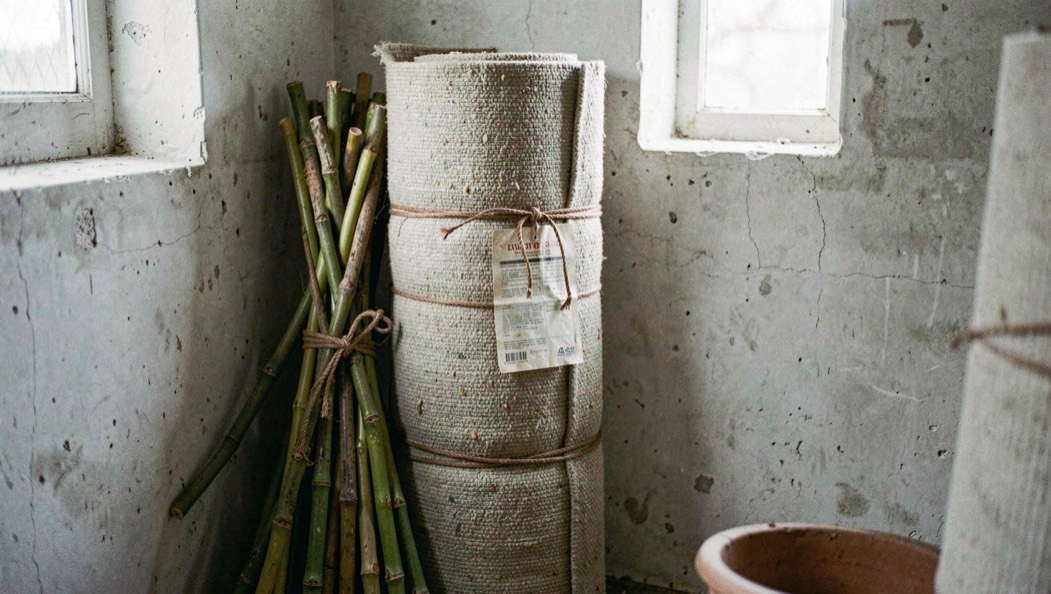
Rolled and tied things stand upright in the corner they are assigned, off the floor on a slat or a brick where damp is possible, each with a label on the tie rather than on the floor. The addressing rule is the same one as letting frequency decide where things live: the rug that comes down each winter stands near the door of the loft, and the one kept for a decade stands behind it.
The corner stays part empty on the principle of the shelf kept bare on purpose: an awkward shape needs room to come out without a fight, and a packed corner is a corner nothing leaves.
The same three knots serve outside the house. The load strapped for the run to the recycling centre, or onto the roof before a departure, is the job described in closing the house for a week, and a load tied with the right three is a load that arrives.
What goes on the tag
A bundle is labelled on the tie, not on the shelf, because a rolled thing on the floor has no face to stick to. A tie-on luggage tag or a folded card under the last turn of cord carries three lines: what it is, its size where size matters, and the year it was tied. The rug rolled for the decade and the rug that comes down each winter look identical from outside; the tag is what keeps the front one reachable and the back one undisturbed.
Tie-on tags survive where adhesive fails, which is the same lesson as labelling that survives a year: the label is matched to the surface it lives on, and on cord the surface is the knot itself.
What it is not
It is not seamanship. Nobody is asking the spare curtain pole to survive a gale; the standard is a bundle that stays a bundle and comes apart by hand. Nor is it tidiness for its own sake: the tie exists to stop the roll springing open, and a bow tied for show is undone the first time the rug is needed.
Learn the three on a length of washing line one evening, and the awkward shapes of the house stop being the pile in the corner and start being addressed, labelled and reachable.
Long leads, spare remote controls and the odd power brick resist every box in the house. The workable method is to tie each one at two points, roll it into a loose coil and bundle it with a velcro strap, then label the bundle with what it feeds and where it lives. Bundles go into a lidded crate by room, not by size, so a cable is found where it will be used. One related job is deciding what sits behind the television before anything is tied: the entry on the soundbar on one remote sets out the lead, the socket and the housing in that order.