Closing the house before a week away
A house left for a week does not need to be cleaned, it needs to be closed: water safe, food managed, one person able to get in. The routine takes an hour and it is written down because the last hour before leaving is the worst time to think.
Most leaving-day anxiety is not about the journey, it is about the house: the tap that might have been left, the milk that will certainly turn, the question of whether the back window was ever locked. A written closing routine moves all of that worry into a checklist that runs in a fixed order, and it is done while the bags wait by the door, not the night before.
A week away on a trail or in a rented place sharpens the point, because the leaving itself is part of the pleasure. The Pine Rose Inn notebook on cabin stays and slow trails makes the same case from the other end: a remote week works when the arrival is prepared, the kit is packed for isolation and the walk is planned with a turnaround time. Their way of planning a ridge with a margin matches the closing routine's way of leaving a house with a margin.
What does the last hour actually cover?
The list runs in the order of the walk out of the house, room by room, ending at the front door. It is shorter than people expect because the goal is not a clean house, it is a safe and unremarkable one.
- Water and gas. The stopcock if the house will be empty more than a few days in winter; taps checked on the walk through each room; the hob checked twice.
- Food. The fridge read like a store cupboard: what will not survive goes to the neighbour, the freezer keeps what freezes. The bin goes out whatever day it is.
- Laundry. Nothing left wet in the machine. A closed drum of damp towels is the smell you meet at the door a week later.
- Light and keys. One lamp on a plug timer is enough. The spare key goes to the person who would deal with a leak, and they know they have it.
- The welcome home. Bed made, sitting room reset, bread in the freezer and milk's arrival planned. The house you return to is decided before you leave.
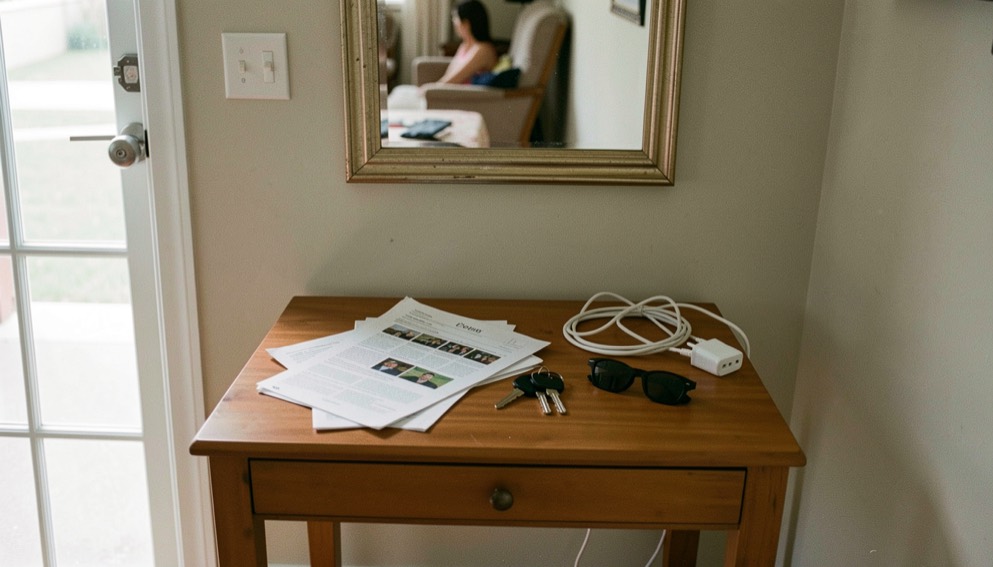
The list is written on the back of the front-door key's tag holder, or taped inside the cupboard by the kettle: somewhere it is seen during the last hour, not filed away with the holiday paperwork. Post is the other small question: the pile on the doormat that advertises an empty house is held by a neighbour with the spare key, or the deliveries are simply paused for the week. The last job outside the house is the load itself: the boot or the roof rack strapped with the same ties that keep a stored rug in its roll, covered in tied, rolled and bundled.
Why does it belong with upkeep and not with packing?
Because everything on the list is the house's business, not the holiday's. The stopcock, the timer lamp and the spare key are the same questions the house asks on the seasonal walk, asked once more before a longer absence. Writing it as an upkeep routine means it sits with the other maintenance habits and gets better each time it runs, instead of being reinvented beside the suitcase.
For the walking itself, the margin that matters is the turnaround: the hour at which the ridge is abandoned whatever the weather. The National Park Service puts it plainly on its hiking safety page: know the route, watch the sky, and let someone at home hold the plan. That someone is the same person who holds the spare key.
What it is not
It is not a security exercise and it is not a deep clean. The house is left in its ordinary good order, the same state the fifteen minute reset produces every evening, plus the short list of things only an empty house needs. Households that leave on Friday afternoon and clean until midnight are doing the wrong job at the wrong time.
And it is not the trip file. The bookings, the maps and the permit printouts live in their own folder, which is what the field-trip file covers. The closing routine assumes the trip is already planned; its job is only the house.
Before locking the door for a week away, walk the house once and settle the small things that fail quietly: the alarm test on each landing, the water shut off at the stopcock, the fridge cleared of anything that will turn. The same round is worth doing at the start of winter, when the nights are long and the household is asleep. Kept sets out a yearly fire-safety round for the house, including an escape plan for night, drawn from the bed outward and rehearsed in the dark. Ten minutes now saves a week of wondering.
A week away is short enough that most systems can be left running, but the order of the closing round still matters. Water off at the stopcock, taps opened to drain the last of it, heating set low rather than off, and the loft hatch checked before the door is locked. On a mountain property the same round is longer, and the snow load and pipes checks that a hard winter forces on a roof and a supply line are worth reading before the first frost rather than after it.