Reading the finish on solid wood furniture
A finish is read with the fingertips and the eye before it is read with the wallet.
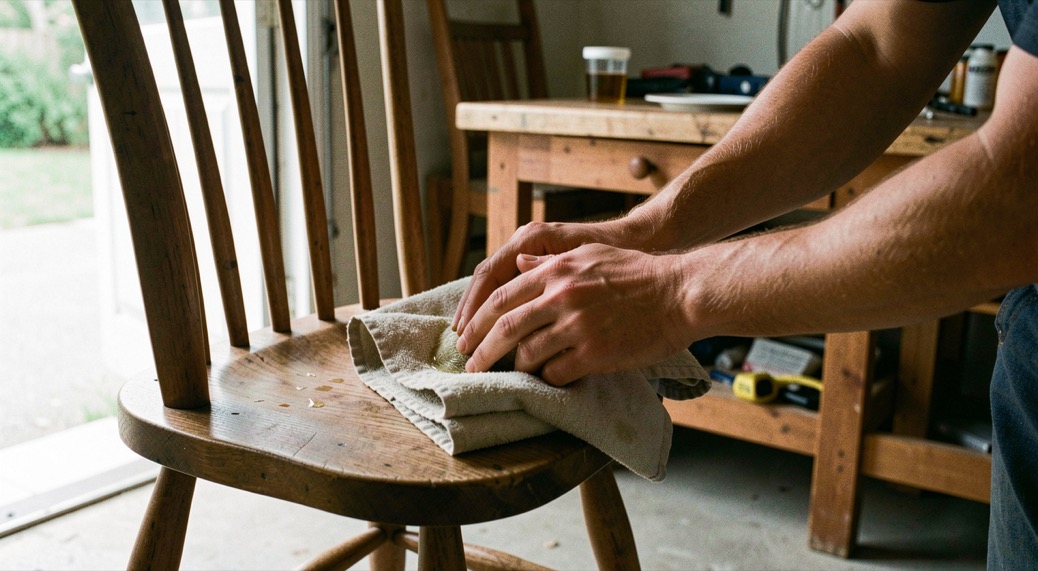
A finish is read with the fingertips and the eye before it is read with the wallet. An oiled surface feels like the wood itself, slightly open and dry, and it darkens where a wet glass has stood. A lacquered surface feels like a separate skin, cool and continuous, and water sits on it until it is wiped. The difference decides how the piece is cleaned, how it is repaired, and how much it will move when the room changes.
How do you tell an oiled finish from a lacquered one?
Oil sits in the fibres. It leaves the grain readable, with a low sheen that shifts as the light moves, and the surface is not perfectly flat because the wood underneath is not perfectly flat. Run a fingernail lightly across the grain: an oiled board answers with a faint, dry rasp. A lacquered board answers with a smooth glide, because the film is on top of the grain, not inside it.
Water is the second test. On an oiled top, a drop of water left for a minute will darken the patch and raise the grain slightly; the mark fades as it dries but does not always vanish. On a lacquered top, the same drop beads and sits. On a modern catalysed lacquer it can sit for an hour without a trace. On an older nitrocellulose lacquer it may leave a white ring, which is the film itself clouding, not the wood.
Smell helps in a workshop or a showroom. Oiled pieces carry a faint nutty or waxy note for weeks. Lacquered pieces smell of solvent when new and of nothing at all once cured. Underneath, the two finishes ask for different care: oil is renewed with more oil, rubbed in thin and left to stand; lacquer is cleaned with a damp cloth and, if it is scratched, repaired by a specialist who can melt the film back into itself.
A third signal is the edge. Where a tabletop meets its side, an oiled finish continues around the corner with the same open texture. A lacquered finish often shows a slightly thicker line at the edge, a bead where the film was built up. That bead is normal and not a fault, but it tells you what you are buying.
For anyone comparing finishes across a range of pieces, the vocabulary used by makers and suppliers is worth learning, and a reference such as wood and furnishing materials in Italy sets out the terms as they are used in the trade. Knowing whether a maker means oil, wax, shellac or catalysed lacquer changes the questions asked in the showroom.
What does a veneered panel do that solid wood does not?
A veneered panel is a thin slice of real wood glued to a stable core, usually plywood, blockboard or MDF. The slice is the same species as solid wood and carries the same grain, so the surface is not a photograph or a printed foil. What the panel does that solid wood cannot is stay flat.
Solid wood moves with the seasons. A wide solid top expands across its width in humid weather and shrinks in dry weather, which is why a solid tabletop is usually fixed with slotted holes or buttons that let it slide. A veneered panel over a manufactured core moves far less, because the core is dimensionally stable and the veneer is thin enough to follow it. That is why wide doors, long sideboards and large wardrobe fronts are almost always veneered rather than solid.
The panel also allows book-matching. Two or more leaves can be cut from the same log and opened like a book, so the grain mirrors across a pair of doors. Solid wood cannot be matched that way without wasting most of the board. The trade-off is at the edges: a veneered panel needs a solid lipping or a careful edge band, and if water reaches the core through a chip, the panel swells and the repair is difficult. Solid wood can be sanded back and refinished many times; veneer can be sanded once, lightly, and no more.
How is a wooden chair joint tightened without stripping the screw?
Most chair joints are not held by the screw alone. The screw pulls the rail into the leg, and the strength comes from the fit of the two surfaces and from the glue that was used when the chair was made. When a chair loosens, the screw has usually been turning in a hole that has worn slightly larger, and tightening it harder only makes the hole bigger.
The first move is to take the screw out and look at it. If the threads are packed with wood dust, the hole is worn. If the screw is bent, the joint has been forced and the rail may be split. A screw that comes out easily, with no resistance at the end, has lost its grip.
To restore grip, the hole is filled, not enlarged. A sliver of hardwood, a matchstick or a length of dowel coated in wood glue is pushed into the hole and left to set, then cut flush. The screw is driven back into the repaired hole with a screwdriver that fits the slot exactly, turned firmly but not forced. If the screw still turns without tightening, the hole is too far gone and the joint should be drilled out and fitted with a slightly larger dowel, which is a workshop job.
Before any of this, the chair is turned upside down and the joints are tested one at a time. A rail that moves when pressed is loose; a rail that is silent is not the problem. Tightening one joint while another is loose simply moves the stress along the frame. Where several joints are loose, the honest repair is to take the chair apart, clean the old glue from the mating surfaces and reassemble it with fresh glue and clamps. That is slower than a screwdriver, and it is the only repair that holds.
Reading a piece before it is moved
A piece that is about to be carried to another room is read for the same signals, with one addition: weight and balance. A solid oak sideboard is heavy in a way a veneered one is not, and the difference matters on stairs. The feet are checked for old repairs, because a leg that has been glued back together will not take a second impact in the same place.
Drawers are pulled out and turned over. A drawer bottom that has shrunk away from its groove tells you the room it came from was dry. A drawer that sticks in one room and runs freely in another is telling you about humidity, not about the drawer. Doors are opened and closed to feel whether the frame has twisted; a door that catches at the top corner in one room and not in another is a frame that has taken on moisture.
What the finish asks of the room it moves into
An oiled piece wants a room that is not too dry and not too wet, roughly the same range a person finds comfortable. It can be refreshed at home with a cloth and a small tin, and it will show its history in the form of small marks that blend rather than sit on top. A lacquered piece wants a room out of direct sun, because the film can yellow or craze over years, and it wants coasters under anything wet.
A veneered piece wants a stable room and a careful hand at the edges. It does not want to stand against a damp wall or under a leaking window, because the core is the part that suffers first and the damage shows as a raised line along the veneer seam.
None of this is a ranking. A well-made veneered cabinet is a better piece of furniture than a badly made solid one. The point of reading the finish is to know what the object will ask for in the years after it is bought, repaired or moved, and to answer those requests before they become repairs.