A kitchen that cooks from the garden all year
A kitchen cooks from the garden all year when the growing is chosen for the pot rather than for the plot, and when the preserving happens on the same evening the vegetables come in.
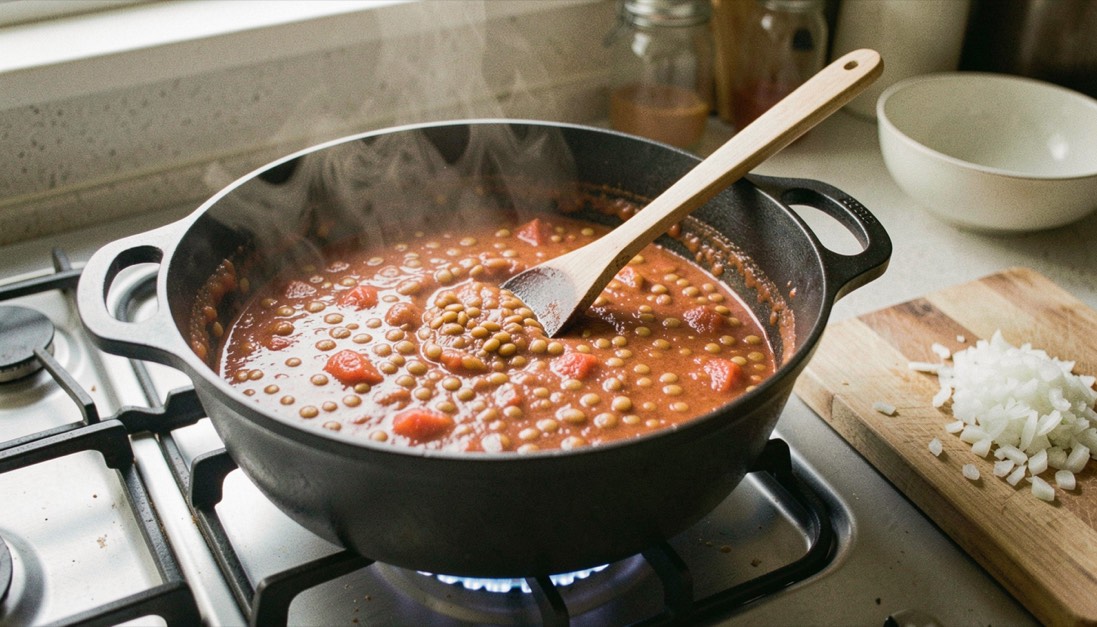
A kitchen cooks from the garden all year when the growing is chosen for the pot rather than for the plot, and when the preserving happens on the same evening the vegetables come in. Small beds, herbs in pots and a few storage crops carry more meals than a large bed of one thing. The kit that makes it quick is small too: a knife that holds an edge, a wide pan, a colander, and jars that stack.
What is worth growing when the kitchen is small?
A small kitchen garden works best when every plant has a job on the plate. Leaves that can be cut and come again give the most meals per square metre: chard, kale, rocket, perpetual spinach, and the outer leaves of lettuce. Herbs earn their space many times over because a handful finishes a dish that would otherwise need shopping. Parsley, chives, mint, thyme and bay will all live in pots on a sill or a step, and mint is better in a pot in any case, since it spreads.
Roots and alliums store without fuss. Carrots, beetroot, onions, garlic and leeks can be lifted and kept in a cool dark place for months, which means the garden keeps feeding the kitchen after the beds are bare. A single courgette plant is usually enough for a household of four; two is a glut. Tomatoes are worth it only where there is sun and air, and even then three or four plants in bags or pots will do more for the kitchen than a long row that ripens all at once.
The rule that keeps a small plot useful is succession. Sow a short row every three weeks rather than one long row in spring, and the same ground gives cut leaves from May to October instead of a fortnight of plenty followed by nothing. Where the soil is heavy or the climate is cold, raised beds warm earlier and drain better, and a cloche or a fleece tunnel buys two or three weeks at each end of the season.
Households that keep both a kitchen and a garden tend to run the same routines indoors and out, and a practical guide such as kitchen, garden and home covers the cleaning, small repairs and seasonal planting that sit alongside the cooking. The point is not to add work but to notice that the same afternoon can serve the pot, the cupboard and the windowsill.
How is a glut dealt with in one evening?
A glut is a timing problem, not a quantity problem. The courgettes, beans or tomatoes that arrive together will not wait, so the evening they come in is the evening they are dealt with. The order that works is: sort, then cook, then store, then clean, and it can be done in about two hours for a standard basket.
Sorting first separates the three destinations. Anything to be eaten in the next three days stays out. Anything firm and unblemished goes for storage or preserving. Anything bruised goes into the pan tonight, because it will not keep. This takes ten minutes and prevents the common mistake of cooking the best produce and binning the rest a week later.
For tomatoes, the fastest route is a wide pan and heat. Halve them, cook them down with a little salt and oil for twenty to thirty minutes, and pass them through a sieve or a food mill if skins are unwanted. The result freezes flat in bags or fills jars for the cupboard. Courgettes are quicker still: grated, salted for fifteen minutes, squeezed, and frozen in portions for soups, fritters and cakes. Beans are blanched for two minutes, cooled in cold water, dried on a cloth and frozen loose on a tray before being bagged, so they do not freeze into a block.
Roots and onions take the slow route. They are trimmed, not washed, and laid out in a single layer in a cool, dark, airy place. A shed, a garage or a ventilated cupboard will do. Check them once a fortnight and remove anything soft, because one rotten root spoils the box.
Fermenting and pickling are the other evening's work, and they need no special equipment beyond salt, vinegar, jars and a weight. A jar of salted beans or a crock of sauerkraut will keep through winter in a cool room, and the work is mostly waiting. Whatever route is chosen, the last twenty minutes of the evening belong to the kitchen itself: boards washed, pans soaked, jars labelled with the date. A glut dealt with in one evening leaves a store cupboard that reads like a menu in January.
Which utensils earn their place on a worktop?
Worktop space is the scarcest thing in a small kitchen, so a utensil earns its place by doing more than one job and by being used most days. The short list is a cook's knife of 20 to 23 cm, a paring knife, a large wooden board, a wide shallow pan with a lid, a colander that doubles as a steamer, a box grater, a pair of tongs, a wooden spoon, a measuring jug, and a set of stacking jars.
The knife matters more than the rest. One that holds an edge makes quick work of tomatoes, onions and herbs, and it is safer than a blunt one because it goes where it is aimed. A wide pan with a lid browns, simmers, reduces and steams, which covers most of what a glut evening asks for. A colander that sits over a pan steams beans and blanches greens without a second pot.
Jars are the quiet workhorses. Straight-sided jars stack, take a label, and show what is inside without opening. A funnel and a ladle make filling them clean, and a permanent marker on masking tape is enough for a date and a name. Nothing here needs to be bought new; a second-hand pan and a good knife sharpened once a month will outperform a drawer of gadgets.
Storage on the worktop should be vertical where possible. A board that stands on its edge, knives on a magnetic strip or in a block, and jars on a shelf above the pan take no counter space at all. The test for any new item is simple: if it has not been used in a fortnight, it belongs in a cupboard, and if it has not been used in a season, it belongs elsewhere.
How does the garden keep cooking in winter?
Winter cooking from the garden is mostly about what was put by, plus what stands in the ground. Leeks, parsnips, kale, winter cabbage and sprouts will hold in cold soil and be cut as needed, which is why they are worth a bed even where space is tight. Herbs move indoors: a pot of parsley or chives on a bright sill gives a handful a week through the dark months.
The store cupboard does the rest. Frozen tomato sauce, blanched beans, grated courgette, dried herbs, pickles and jars of fruit carry the kitchen from November to March. A monthly check of the shelves, moving older jars to the front, keeps the stock turning and prevents the discovery of a forgotten crate in April.
Sprouting seeds fill the gap cheaply. A jar, a piece of muslin and a rinse twice a day give fresh green in three or four days, on a windowsill, at any time of year. It is the smallest possible garden and it keeps the habit alive when the beds are frozen.
Keeping the year turning
The garden and the kitchen run on the same calendar: sow, cut, cook, store, and clean up. A small plot, a short list of utensils and one evening set aside when the glut arrives will carry a household through the year with less shopping and less waste. The work is ordinary and repetitive, which is exactly why it holds.
A note on the tools
Nothing in this routine depends on new equipment. A sharp knife, a wide pan, a colander, jars and a cool dark shelf cover the whole of it. What changes the year is the habit of dealing with what the garden gives on the day it gives it, and of keeping the worktop clear enough to do so.
The planting dates and spacing in this entry rest on the Royal Horticultural Society vegetable pages, which set out sowing windows, bed spacing and rotation for each crop. Those pages sit outside this household record and are named here only as the source of the facts. Nothing on this site is a partner or a sponsor of that body, and no payment passes either way. The kitchen keeps to the calendar, the garden keeps to the soil, and the record stays plain.
A kitchen that cooks from the garden all year leans on what is already on the shelf. Salt, oil, vinegar, coffee grounds and clay do more than season: they preserve, clean and mend, and a jar of any of them keeps for weeks. Kept files these under Provisions, in a store cupboard of simple things, where the foot soak and the sugar scrub sit beside the garden notes, since both draw on the same few ingredients. The second entry follows that thread through the year.