Before a kitchen garden: the questions a household settles first
A kitchen garden is decided before it is dug, in winter and on paper. The questions are about time, space and appetite rather than about varieties.
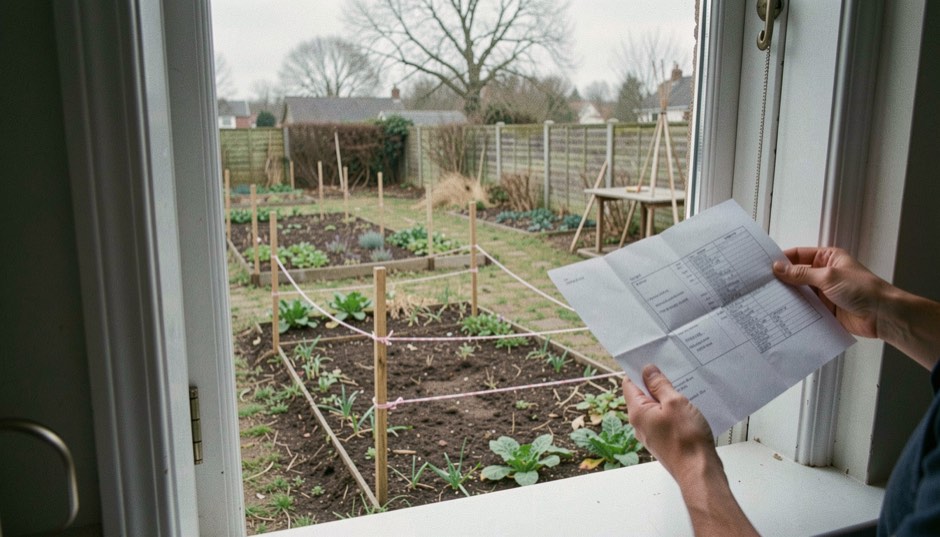
A pantry list assumes the shops. The week it assumes a garden instead, the questions change: the household stops asking what to buy and starts asking what it can keep alive. A kitchen garden is settled before the first seed is ordered, and the settling is done in the currency a household already keeps, time, space and appetite.
None of the questions is complicated, but each has to be answered honestly, because a garden forgives an enthusiastic start less readily than it forgives a realistic one.
What does a plot ask of a week?
The first question is time. A kitchen garden wants the little and often rhythm of the weekly hour rather than a heroic Saturday: fifteen minutes of weeding twice a week beats an afternoon of rescue in July. The honest version of the question is which existing routine can absorb the garden, and the answer is written down before the digging starts.
A full allotment asks more: a standing half day a week through the growing season, and somebody who actually goes. That is still smaller than it looks on paper, but it is not small, and a household that cannot find the half day is better served by two beds against the house than by a plot visited in guilt.
The routine also wants a name. A plot kept by the household in theory is kept by nobody in practice, and the sheet says who owns the half day, who covers it in holiday weeks, and what happens in the fortnight everyone forgets.
How much ground is enough?
The second question is space, and the arithmetic is done before the seed catalogue is opened. A bed or two answers most of what a kitchen wants; a rented plot answers more and demands proportionately more. What to grow first is the smallest question of the three and the one the catalogues make hardest: salad leaves, courgettes, beans and the herbs the kitchen reaches for weekly are the vegetables that pay. The Royal Horticultural Society's grow-your-own pages keep the same short list for a first season, and anything beyond it is grown for pleasure rather than for the pantry.
Measure the ground before committing to it. The difference between a bed and a plot is not only square metres but the standing commitment of a weekly visit, and a household that has paced it out in advance rarely regrets the smaller choice.
Where does the plot go?
The third question is position, because a kitchen garden is visited at cooking speed. A bed beside the kitchen door is picked every day; a plot ten minutes away is picked on Sundays, and the difference decides what can be grown. Cut-and-come salads and herbs belong within reach of the hob, the heavy croppers can live further off, and anything a walk away is planted as a crop rather than as a habit.
Light and water come second, and they come together: a bed that needs a hose hauled across the garden is a bed that dries out in the first hot week. The questions are boring and they are the whole of the decision, because a garden moved after the first season is a garden started again.
It is worth standing in the candidate spot once, at the hour dinner is cooked, before deciding. The spot that is visible and passed daily gets kept; the spot behind the shed, chosen for tidiness, is where gardens go to be forgotten in their second year.
What gets written down before the season?
The answers land on a single page: the beds drawn roughly to scale, the crop for each, the sowing months marked on the household calendar rather than on a separate gardening diary. The page lives with the pantry list, because the pantry is what the garden is for. It says, in effect, which jars and freezer drawers the summer is expected to fill.
The page also carries the household's honest fail-safe: the shops still exist, and a failed courgette is a disappointment rather than a famine. Writing that down is not pessimism. It is what lets the first season be small, which is the only size a first season should be.
What does the garden do to the pantry?
A garden does not feed a household evenly, it feeds it in waves. The beans arrive all at once, the courgettes exceed any reasonable need by midsummer, and the pantry list that fitted the winter stops fitting. The discipline that keeps the store cupboard honest, first in, first out, applies to the harvest doubled: what cannot be eaten, cooked or given away within the week is a crop grown for the compost heap.
The preserving jar and the freezer drawer join the pantry list the summer the garden starts, and the pantry itself gets a mid-year review rather than a yearly one.
The surplus has a second home that most households forget: the local produce show, where small growers have put up a single plate of beans for a century. The allotment notebook Notes from W4 writes the bench down properly, from how a class is entered to how the produce is cut and staged, and a household that grows beyond its own needs will find the show schedule the oldest known answer to a glut.
What it is not
It is not self-sufficiency, and it is not a saving. A kitchen garden grown well pays in flavour, habit and the odd week when the shops are an afterthought; grown badly it is an expensive way to buy guilt by the seed packet. The question list exists so that a household digs only what its week can hold.
The first version is one bed, one season and one sheet of paper: what the household actually eats, which of it the garden can supply, and whether the weekly routine can take it. The pantry list is then revised in June, when the answer arrives on the kitchen table.
Water is the question most households answer too late. A bed in a dry summer wants roughly 25 to 40 litres per square metre each week once established, given slowly and early, and less where the soil is mulched and the bed sits in afternoon shade. New beds take about twice that for two seasons. Kept sets out the figures in its entry on a dry-climate garden, useful for judging where shade helps most before any seed is ordered.
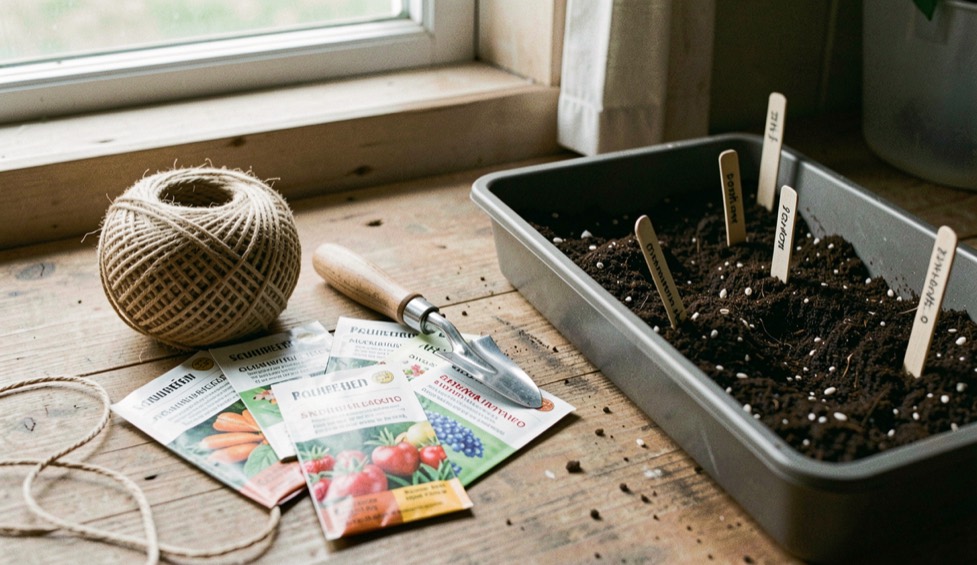
A household settles the questions before it buys a single seed: who will water on weekdays, where the trays will stand, and what happens to the plants in late spring. Light is the first constraint. A south-facing windowsill in February gives far less than most people assume, and a north-facing one much less again. Seed can be started indoors from late January, but only if the tray is turned daily and the seedlings are moved on before they stretch, which is where pricking out a seedling begins.