A family-history folder that survives its subject
Family research has a known failure: it lives in the head of the person doing it. The folder exists so that someone opening it in twenty years can see what was found, where it came from and what was never resolved.
Every family has the box: certificates, photographs with no names on the back, a great-uncle who is three different ages in three different tellings. The box survives because it is paper. The research usually does not, because it lives in a subscription account, a browser's history and the memory of whoever got interested.
The folder is the boring solution. One document wallet per line of the family, everything in it either a copy of a source or a note that says where the source was seen.
The visit sheet is where the folder meets the street. A name on a civic memorial is a source like any other, and reading it properly is a skill: how the names are ordered, what the stone is made of, when it was dedicated. The Tadcaster War Memorials project keeps exactly that record for the Tadcaster war memorials, following the men named on the town's stones through their service papers, their wounds and their pensions, alongside the home-front record of tribunals and rationing. The Commonwealth War Graves Commission register is the wider lookup when the name leads beyond the town.
What does the folder hold?
Copies, citations and the question sheet. Nothing original goes in unless the household is the only place it exists: a birth certificate ordered from the register office is a copy; the only photograph of a grandmother is an original and belongs in a sleeve, not loose.
- The tree, printed. One page, dates only, names spelled as the sources spell them. It is reprinted when it changes, not annotated in pen.
- The copies. Certificates, census pages, service records, each with its source written on it in pencil at the time it was printed.
- The question sheet. The names not yet found, the contradictions not yet resolved, what was already checked and where it failed.
- The visit sheet. Where the family's names are written in stone: memorials, graveyards, plaques, with what was found on the day.
Why do the citations matter more than the finds?
A fact without its source is a rumour the next generation has to check again. The pencil note on each copy is what separates the folder from the box: it says which archive, which register, which website and which day it was read, so the work is never done twice and a wrong turn can be seen to be a wrong turn rather than repeated.
The cheapest research in the whole subject is the conversation with the oldest living relative, and it is also the one with the closing date. Their answers go on the question sheet the same day, with names spelled out loud and corrected on the spot, because a name half-remembered and written down wrong sends the archive work off in a direction it may never come back from.
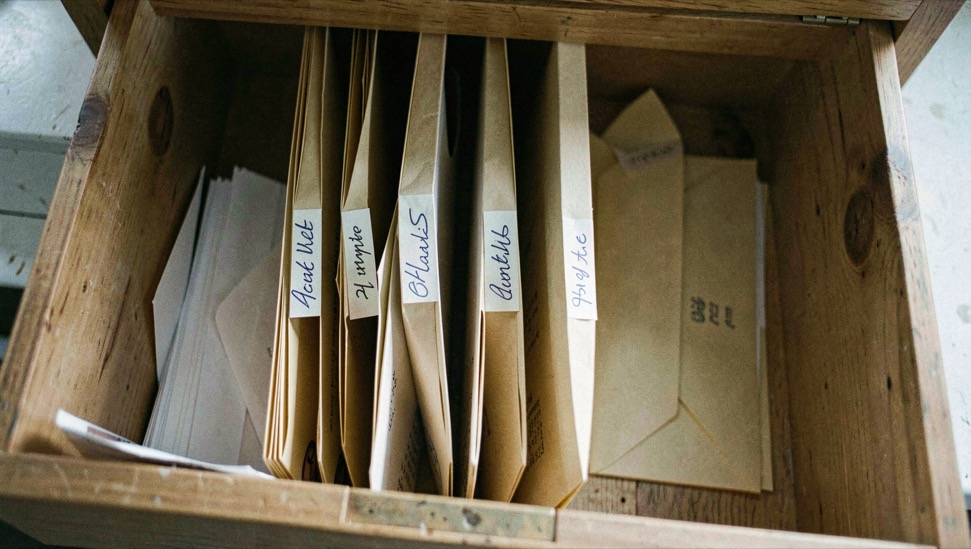
The folder lives with the other permanent records, in the same drawer as the household inventory, and a memorial visit folded into a day out runs on the same paperwork as the field-trip file. What is digital stays digital in parallel, but the paper copy is the one a stranger to the family could pick up and read cold, which is the whole point of it.
What it is not
It is not an archive and it is not a display. Originals stay in sleeves, copies stay in the folder, and the folder's job is to be read, not to be impressive. And it is never finished: the question sheet at the front is the honest part of it, the list of what the family still does not know.
It is also not private in the way the rest of the drawer is not private. The folder is written to be inherited: whoever takes it over should be able to continue the questions without decoding the keeper's shorthand. Plain sentences, full names, sources spelled out; the conventions of the paper drawer apply to it exactly.
A family-history folder outlives the people it describes, and it usually outlives the house. The paper inside is the slow part: light, damp and its own acidity work on it for years, long after the last person who could name the faces has gone. The same habits that serve a picture hanging on plaster serve a folder, flat, face protected, nothing pressing on the surface. Kept files the picture version under Storage; the folder asks for the same few minutes twice a year.