The rainy-day shelf: preparing a house for days when nobody goes out
A wet Saturday with children in the house is survivable when the kit already exists. The rainy-day shelf is a small reserve of things to do, kept out of sight the rest of the year so that it still works when it comes down.
The shelf works on scarcity. Toys that live in plain sight are spent; the rainy-day kit survives because it appears only when the weather or the winter demands it. It is stored high or boxed, and its contents are chosen so the whole of it fits on one shelf and one hour of it buys a quiet room.
What should a rainy-day kit contain?
- Cards and dice. The whole of it in two small boxes, good for every age from five up and for adults once the children are in bed.
- Paper, pencils and the mess-controlled crafts. Colouring, cutting, folding. The kit holds what can be cleared in five minutes, not the paint.
- One building thing. The wooden blocks, the dominoes or the track that can fill a floor and an afternoon.
- A folded blanket. For the den, which is still the fastest way to turn a wet afternoon into somewhere the children have built.
- The idea list. Written down, because at eleven on a rainy morning nobody invents anything.
For the list itself there is no need to start from nothing. Very Super Kids keeps a forty-idea kit of rainy-day activities for kids, sorted by the age bands that actually matter, one to three, three to five, six to ten, with every idea tested against the same rule this shelf runs on: ordinary household materials, honest about the mess, and able to start inside a minute. The NHS's Healthier Families activity pages cover the days the rain does lift and someone still needs to move.
How do you keep different ages busy in the same room?
By running the room in parallel rather than in series. The six-year-old's construction and the toddler's bowl-and-spoon game coexist if they are given different corners and the older child's pieces stay above the low line where the house is read at eye level. The kit is packed with the mixed ages in mind: nothing with a hundred swallowable parts, everything survivable by a sibling's help.
Which indoor games need almost no equipment?
The ones the household already knows, which is the real point of the idea list: it records what worked last winter so the wet weekend does not start from zero. Hide-and-seek, the tray of objects memorised and guessed, the long game of cards: these need nothing but the room, and they are the reserve behind the reserve when the shelf's contents have been exhausted.
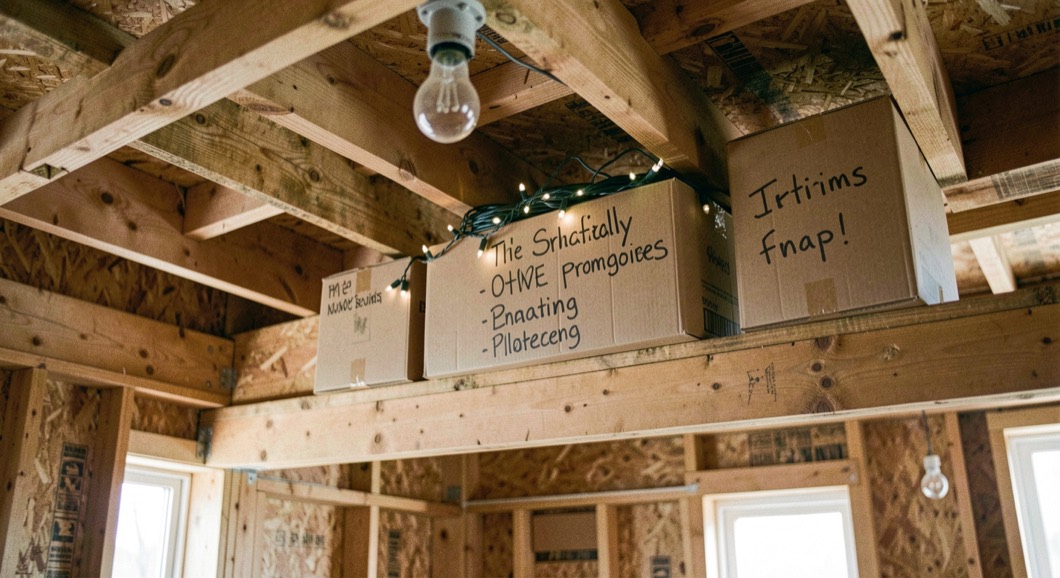
The shelf is also rotated, lightly. Once a season, during the same pass that turns the wardrobe, one thing comes out and another goes in: a puzzle that was too young, a new pack of cards, the craft kit bought in a moment of optimism and saved for exactly this. Rotation is what keeps the shelf a reserve rather than a museum of toys the children have grown past. What grows past entirely is a different question: the toys that leave the shelf for good join the loft in a labelled box, kept the way childhood soft toys are put away so they come back whole.
And the shelf has an adult use. A power cut, a week of flu, the long evenings of January: the cards and the blanket serve the grown-ups as readily, and a household that can occupy itself without a screen for an evening is a more comfortable house than one that cannot.
What it is not
It is not a second toy cupboard, and it is not a screen policy. The shelf holds what the house can clear away; the games evening it becomes when the children grow is the same room used the way a games evening at home describes. Where the shelf sits follows the ordinary rule: frequency decides where things live, and a thing used a dozen times a year lives high, near the room it serves, in one labelled box.
And it is not a bribe. The shelf comes down because the weather closed the day, not because the children earned it, and it goes back when the weather lifts rather than when it is finished with. The household that treats it as a reward empties it inside a month; the one that treats it as weather equipment keeps it for years.
On a wet day the shelf by the back door earns its place. Seed packets, the feed scoop and the small trowel stay within reach, so a break in the rain is enough to sow, feed or tidy without a search. The lidded box below holds what the season does not need, and one clear-out a year keeps it honest. For the wider question of what comes indoors in autumn, the same shelf sets the rule: only what is used weekly stays out.