Where an instrument lives between sessions
An instrument that has to be excavated does not get played. The question is not where to store it but where to keep it, which is a different answer entirely.
A house that contains a banjo, a fiddle or a guitar contains an object that is used in short bursts and should be reachable in under ten seconds. Practice happens in the gaps: the ten minutes while the potatoes boil, the half hour after the children are in bed. If the instrument lives in a case, under a bed, behind a door, those gaps close over it.
The rule is the same as for every other object in the house: frequency decides where it lives. A thing used daily earns a place in the open. A thing used twice a year earns the loft.
For anyone weighing up a first five-string, the deciding factor is usually the same as the storage one: what gets picked up gets learned. The Fifth String, an Irish notebook on bluegrass and old time, writes plainly about getting started on the five-string banjo, including what a first instrument in Britain or Ireland actually costs and what the capo and the fifth string are for. The Bluegrass Music Hall of Fame keeps the instruments and their history for the days when the motivation, not the kit, is what runs out.
Where should it live?
In the room where it is played, at arm's height, off the floor. A wall hook with proper padding, a stand in the corner of the room that is actually used for music, or a shelf deep enough to hold a case on its side. Not the spare bedroom, not the top of the wardrobe, and never anywhere that requires moving another object first.
- Away from the radiator. Wood moves with heat. A hook beside a warm wall is a slow warp, and a window with direct sun is not much better.
- Away from the door swing. The instrument on the stand in the hallway is the instrument that meets the door.
- The case lives open or closed, not between. An open case under the bench invites a trip; a closed case on a shelf reads as packed away. Pick one state per instrument.
- One shelf for the small kit. Tuner, capo, spare strings, picks and the strap live in one box beside it, because a lost capo ends more practice sessions than a broken string.
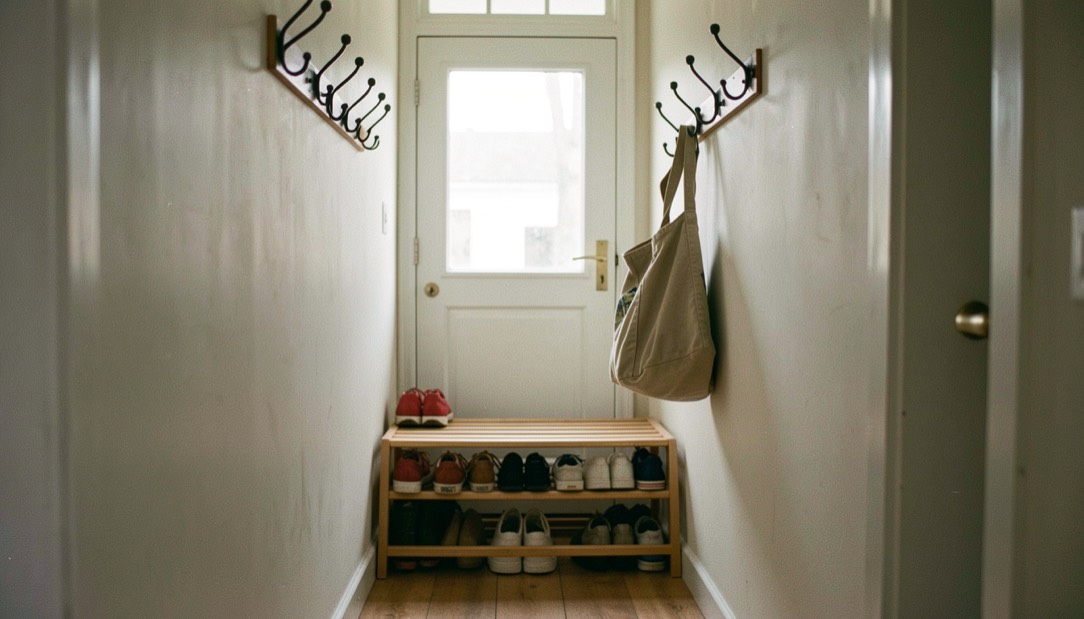
Why does the visible hook beat the closed case?
A cased instrument is storage. A hung instrument is furniture. The difference shows in the practice log: the banjo on the hook gets picked up because it is there, the same way the biscuit tin gets opened because it is on the shelf. The sight of it is the reminder, and reminders are the whole mechanism of a practice that survives a working week.
The counterargument is dust and knocks, and both are real. Dust is handled by a cover cloth thrown over the headstock and by the instrument's place in the fifteen minute reset. Knocks are handled by position, which is what the hook rules above are for.
Humidity is the slower argument. A wooden instrument kept in a damp room opens at the seams, and one kept beside a working radiator dries and cracks. The middle of the house, neither the cold spare room nor the radiator wall, is where the wood is stable, and in a hard winter a dampened sponge in a pierced bag inside the case does what a humidifier would.
What it is not
It is not a display. The hook is working storage, and an instrument hung where nobody will ever take it down is decoration, which is a different decision and should be made as one. Nor is it permission to multiply: the rule works for the instruments in weekly rotation. The mandolin bought in January and untouched since is an object to be honest about, which is the conversation in the empty shelf.
The same logic covers the rest of the household's hobbies: the thing that is played is kept out, the thing that is kept is stored properly. Where the two get confused, the house fills with objects that are neither. The awkward shapes that fit neither hook nor case are another method again, stored standing once they are tied, rolled and bundled.
An instrument kept in its case between sessions holds its tuning longer, but the case itself needs watching. Felt linings hold dust and damp, and a dry room will pull at the wood of a neck or a body the same way it pulls at a table. Wiping the strings and the body after playing takes a minute. Before deciding how to clean or repair the surface, it helps to know whether it is oiled or lacquered, since the two behave differently when water or sweat sits on them.