A dry-climate garden: water, shade, ground cover
A planted bed in a dry summer needs roughly 25 to 40 litres per square metre per week once it is established, delivered slowly and early in the morning, and rather less if the soil is mulched and the bed sits in afternoon shade.
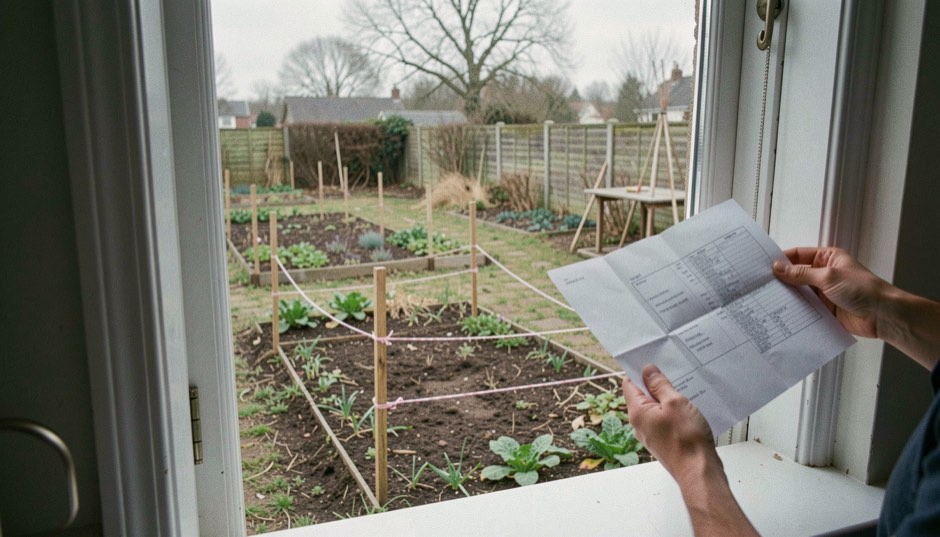
A planted bed in a dry summer needs roughly 25 to 40 litres per square metre per week once it is established, delivered slowly and early in the morning, and rather less if the soil is mulched and the bed sits in afternoon shade. Newly planted beds need about twice that for the first two seasons, because roots have not yet reached the moisture that survives at depth. The figure is a starting point, not a rule: a bed of lavender and rosemary on a south wall will drink less than a bed of hydrangeas in the same soil, and a clay soil holds water far longer than sand between waterings.
The arithmetic matters because it decides how the garden is laid out. A house in a dry climate is easier to keep when the planting is grouped by thirst rather than by colour, with the heavy drinkers close to the tap and the dry ones sent out to the boundary. Readers looking at how this is handled across a whole village, from the 1928 Covenant to the equestrian trails and the dry-summer gardens of the north San Diego county interior, will find the pattern described in detail at Santa Fe homes and land, where the relationship between architecture, plot shape and planting is treated as one subject rather than three.
How much water does a planted bed need in a dry summer?
Measure the bed, then measure the water. A square metre of established shrubs and perennials in a dry-summer climate uses somewhere between 25 and 40 litres a week in July and August, which is the equivalent of 25 to 40 mm of rain that never falls. A bed of 20 square metres therefore wants 500 to 800 litres a week at the height of the season, and that is a figure a household can check against a meter reading rather than guess at.
Three things move the number up or down. The first is mulch: 75 mm of coarse bark or gravel over the soil surface cuts evaporation enough to matter, and it keeps the root zone cooler through the afternoon. The second is the soil itself. Sandy ground drains fast and needs smaller, more frequent doses; clay holds water and can be given a longer soak less often, provided it drains at all. The third is the plant list. Mediterranean herbs, native sages, olive, cistus and most of the dry-climate palette will survive on the lower figure once established; anything with large soft leaves will not.
Watering early is not folklore. Between about five and nine in the morning the air is still, the soil is cool, and the water reaches the roots instead of leaving through the leaves. Evening watering leaves foliage wet overnight, which is how fungal problems begin. A drip line or soaker hose under the mulch delivers the water slowly enough that it soaks in rather than running off a slope, and it puts the water where the roots are rather than on the path.
The first two summers are the expensive ones. A new bed needs roughly double the established rate, in more frequent doses, until the roots have spread. After that the same bed can often be cut back by a third, and in a wet winter it may need nothing at all.
Where does shade do the most good around a house?
Shade earns its place first on the west and south-west faces, where the low afternoon sun hits the wall and the glass. A tree or a pergola on that side lowers the surface temperature of the wall itself, which is the part of the house that keeps radiating heat into the evening. Shade on the east side helps in the morning but matters less, because the air is cooler then and the sun is higher.
Plant the shade where it also shelters the ground. A tree placed to the west of a bed does two jobs at once: it shades the wall in summer and it shades the soil, which cuts the water demand of everything under it. Deciduous trees are the better instrument in a climate with cold winters, because they drop their leaves and let the low winter sun through to warm the house when it is wanted.
Shade is not only for the building. A shaded path along the north side of a house stays usable in August, and a shaded seat near the kitchen door is where the household actually sits. The mistake is to shade the middle of the lawn, which needs sun, and to leave the west wall bare, which does not.
Distance matters as well. A tree planted too close to the wall lifts paving, blocks gutters and drops debris on the roof. The usual guidance is to set a tree at least its mature canopy radius away from the building, and further for anything with aggressive roots.
Which ground covers hold a slope and need little water?
A slope fails when water runs down it faster than it can soak in, taking the topsoil with it. The ground cover has to do two things: root deeply enough to knit the surface, and spread widely enough to close the canopy so rain reaches the soil rather than the bare ground between plants.
Among the low-water options, several earn their place on a dry slope. Creeping thyme forms a dense mat, tolerates foot traffic and takes full sun on poor soil. Dymondia margaretae, a silver-leaved carpet from South Africa, is widely used on slopes and between paving in dry-summer climates and needs little once established. Myoporum parvifolium spreads quickly on banks and holds them while slower plants fill in. Rosemary, prostrate forms especially, roots as it runs and will hold a bank on its own. Native grasses and sedges, including blue fescue and deer grass, hold soil with fibrous roots and need no summer water once established. On hotter, steeper ground, low ceanothus and creeping manzanita do the same job with a deeper root.
Planting pattern decides whether the slope holds in the first winter. Setting plants on a staggered grid, closer than the mature spacing would suggest, closes the canopy sooner. A shallow basin on the downhill side of each plant catches water before it runs off. On steep ground, a biodegradable net or a line of rough stones across the fall of the slope buys the first season, until roots take over the work.
What the three answers have in common
Water, shade and ground cover are one decision made three times. A bed that is grouped by thirst needs less water; a tree placed on the west side supplies shade to the wall and to the soil beneath it; a ground cover that closes its canopy holds the slope and lowers evaporation from the ground it covers. Each choice reduces the demand made by the others.
The practical sequence is to measure the bed, mulch it, water it early and slowly, then plant the shade before the plants that will live in it. A slope is planted the same way, from the top down, with the fastest spreaders set first so that the soil is held while the slower and longer-lived plants establish.
None of this requires a particular style of garden. It requires knowing how much water falls, how much the bed uses, and where the sun lands on the house through the afternoon. Those three numbers, written down once, will answer most of the questions a dry-climate garden asks for years.
The figures on water use and ground cover in this entry rest on outside material rather than on the household's own notes. The water education pages set out how much water a dry-climate garden takes, how shade changes it, and what ground cover does to the soil beneath. That source is not a partner or a sponsor of this site, and nothing here is sold on its behalf. It is named only so the numbers can be checked. Where the two disagree, the household's own meter readings stand.
In a dry-climate garden, water is rationed by the soil, not the can. A mulch of gravel or coarse compost holds what rain falls, and shade cloth at midday spares the leaves the worst of the sun. Ground cover does the same work more slowly, knitting the surface so bare earth does not bake. Where the season starts too early for direct sowing, a tray on a windowsill can raise the first plants, and the entry on sowing a tray indoors sets out the light and turning that seedlings need before they go out.