The seasonal walk around a house
Four times a year, walk the outside of the building and then the inside, in the same order, looking for water. Most household repairs begin as something you could have seen.
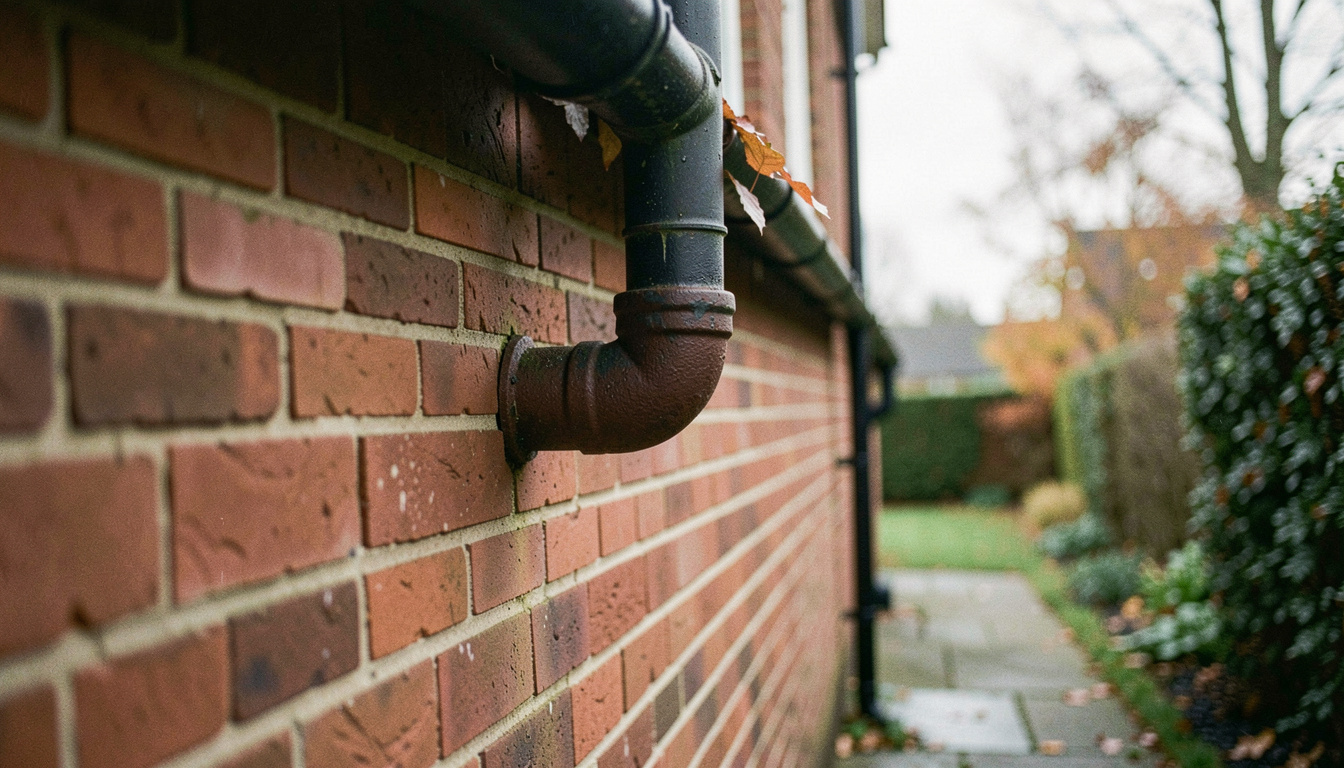
Almost every expensive household repair started as something visible. A gutter joint dripping onto a wall for two winters, a sealant bead that had shrunk away from the bath, a slate that slipped in a March gale and was never looked at. None of those cost anything to find. They cost a great deal to leave.
The seasonal walk is the habit that finds them. Four times a year, once at the change of each season, walk the outside of the building and then the inside, in the same order, looking for one thing above all others: water, and where it is going.
The route outside
Start at the front door and go round the building in one direction, looking up as often as down. Twenty minutes is enough for a terraced house, forty for a detached one with outbuildings.
- Roof line and gutters. Sagging runs, plants growing in the gutter, dark vertical staining below a joint. A stain on brickwork is a leak that has been running long enough to be visible from the ground.
- Downpipes. Follow each one to the ground and check it enters the gully rather than the soil beside it. Blocked gullies show as a fan of silt on the path.
- Walls at ground level. Look for soil, decking or a raised bed piled above the damp proof course, which is usually two brick courses above the ground.
- Windows and doors. Press a fingernail into the timber at the bottom corners of wooden frames. Soft timber means water has been sitting there. Check that trickle vents are clear and that sealant is intact rather than merely present.
- Paths and drains. Water should run away from the house. Check drain covers lift, and lift one to look.

The route inside
Inside, walk the same direction, room by room, and look at the places nobody looks: the ceiling corners, the wall behind the bed, the back of the cupboard on the outside wall, under the basin, behind the washing machine, the loft hatch.
The signs are small. A ceiling stain the size of a coin, a hairline crack that is wider at one end, a musty smell in a wardrobe against an external wall, black spotting on the sealant of a shower tray, a patch of wallpaper that has lifted at a seam. Take a torch, because damp shows up in raking light and disappears under a ceiling bulb.
What belongs to which season
The four walks are not identical. Each one is timed to catch something specific. That timing is the whole of a house kept by season: each quarter's round carries the jobs that only make sense at that turn of the year.
- Early autumn. Gutters and drains before the leaves fall, heating tested before it is needed, radiators bled, boiler service booked while engineers are still available.
- Midwinter. Condensation patrol. Cold external walls, window reveals, behind wardrobes. Check the loft for daylight and for wet insulation after a gale.
- Early spring. Storm damage: ridge tiles, fence posts, felt on the shed roof. Outside taps and any pipe that froze.
- Midsummer. The paint and timber walk. Repaint while it is dry, clear vegetation off walls, check that the loft is not overheating and that vents are open.

Write it down or it did not happen
Take a phone and photograph anything you are not sure about, then look at the same corner three months later. A stain that has not changed in three months is old and probably dry. A stain that has grown by a hand's width is live, and that comparison is impossible from memory.
Keep the notes in one place with dates, alongside the appliance details and service records. That is what a household inventory written once is for, and it is also what turns four disconnected walks into a record of how a building is behaving over years.
Anything found on the walk goes straight onto the maintenance calendar with a month against it. Anything that can be done in ten minutes with what is already in the house should not go on a list at all, it should go on the short running list that gets cleared in one pass of small jobs. The same walk, run once before a week away, becomes the closing routine of closing the house for a week with a different purpose. For a household whose boundary runs beyond the garden, the walk continues in the same circuit around a piece of land, at the same quarter days.
Where the walk stops
The walk is a survey, not a repair session. Carry a torch, a screwdriver and a phone, and nothing else, because the moment you carry tools you will start a job and the other three sides of the house will not be seen.
It also stops at the point where a ladder is needed. Roofs, high gutters and anything above single storey are looked at from the ground with binoculars or from an upstairs window. The purpose of the walk is to notice, and noticing does not require height.
Do the first one in whatever season you are in now, and write the date at the top of the page. The second walk is worth far more than the first, because it is the one that shows you what has changed.
The seasonal walk around a house is also the moment to look at the deck, where the boards meet the joists and the cladding sits over its cavity. Acacia moves with the weather, so a board fixed too tight in spring will lift by autumn. The useful check is to note the span between joists and the thickness of each board before ordering replacements. choosing exterior timber for a deck sets out the thicknesses and centres that keep a ventilated facade working.
The seasonal walk around a house is a slow loop, done four times a year, that catches what a daily glance misses: a lifted slate, a damp patch under a pipe, a door that has begun to stick. It costs an hour and saves a season of repairs. On higher ground the same walk has more to find, and checking a mountain property before winter is the entry that sets out what snow load, pipes and access ask of an owner.
On the seasonal walk, the planted bed is the part that asks for a decision rather than a glance. In a dry summer an established bed wants roughly 25 to 40 litres per square metre each week, given slowly and early, and less where mulch and afternoon shade do their work. New beds need about double for two seasons. Where a cover that holds a slope has been planted, the same walk tells you whether the ground is holding or drying.
The walk also passes the windowsills, and it is worth pausing there. A south-facing pane in February gives perhaps a tenth of the light a seedling would get outdoors in May, and a north-facing one far less, which is why a tray started in late winter needs turning daily and moving on before the seedlings stretch. Anyone weighing how much light a window gives will find the point set out plainly, and can plan the sowing around it rather than against it.